Frugal Vegetable Gardening

I have been told by some people that it is to expensive to begin growing vegetables. By the time they purchase soil and pots or planters, the seeds or seedlings, fertilisers, it all adds up. They just can not afford it. Or composting is such hard work.

I was able to pick up pots of varying sizes from a gardening shop in Hobart for free. These were just plastic pots that people bought in to recycle and others could take and use. Rather than just throwing them out. Any second hand pots I suggest just a wash in hot water with dish washing detergent and dry in the sun. I have also been able to purchase from my local tip shop chipped and cracked ceramic pots and garage sales you can also pick up cheap pots sometimes with plants in them. (if you dont like the plant give it to someone and keep the pot). Also look out for hard rubbish pick up days.

However you do not have to have plastic pots or lovely ceramic pots to grow plants in. You can use all sorts of things. Tin cans, have been used by many people for a long time to grow veggies. I have used large veggie oil cans and biscuit tins. Drill a few holes in them, they are a pot.
Plastic storage boxes can be used, polystyrene boxes, I can usually get mine for free from seafood shop veggie shops sometimes my local supermarket.

Now for soil, here is a wonderful Youtube Channel Robbie and Gary Gardening Easy. Wonderful for those who want to begin to grow some veggies. Robbie grows veggies in her own soil/compost that she makes from scratch. It is so easy and involves little work. I have been doing it and it is brilliant! She saves all her kitchen scraps puts them in a plastic container, or container with holes drilled in it, uses the weeds she pulls up before they seed, and places them at the bottom of the container. She puts her scraps straight into the container, waters it a bit, and places a lid/cover with a weight on it to stop animals getting into it.

Because you have drilled/put holes in the bottom worms will make their way into the scraps and begin to break down the food scraps into wonderful soil/compost. Add dead or leaves and paper if you wish. Robbie can explain her system here.
https://www.youtube.com/watch?v=b6eSaIEz2rQ

I also compost in place, meaning I will just put any leaves I pull off or that have fallen off I leave there in the area to compost in the bed. I will break up the stems and some plants such as legumes I leave the roots as when they break down they release nitrogen in the soil.

Some advice I will give you about seeds and seedlings. When I first started my vegetable gardening here in southern Tasmania, I was caught out by buying seedlings that were totally inappropriate for my location. The nurseries and gardening centres were selling seedlings, so I assumed they would be fine. Unfortunately no. Some were way to early for planting outside, and were actually for people to grow in hot houses/green houses/poly tunnels situations. Or were just not seedlings that were ever going to do any good down here.

One of the problems with purchasing seedlings from large garden centres and nurseries is that the seedlings may not have even been grown for this area. Same problem can occur with seeds. Some seed do not grow for me so well from big suppliers. I am in the fortunate position that we have a couple of relatively local seed savers who have began businesses that have seeds that they have grown and saved from the fruits, here in the area I live. I see a big difference in how they perform to how the others I have in the past purchased.

Being involved in a seed saving community group, and my local Crop Swap group has been marvelous as I get seeds and seedlings for no financial cost. Where seeds and seedlings as well as produce and anything related to veggie growing and food, can be shared. For the seed saving you grow one variety of say a bean that year, and you try to keep it pure. You can share some of the fresh peas or beans and then the majority you save for seed. Sharing and some will be saved so we have a supply of local seeds available if there is a crisis such as the bush fires here last summer (2018-2019) the crop swap group grew seeds and gave seedlings to the people who had lost their veggie gardens due to be evacuated and their veggie gardens were not watered so died. A simple thing the group did but such a welcome and unexpected thing. Others grew trees to help replace trees for free.

My growing awareness of the importance to monitor flowering of my veggies especially the brassicas, as they will cross pollinate, as will tomatoes, and other vegetables. I am also much more alert as to flowering weeds. Some I am happy to have flower as bees and birds will feast on the seeds Some such as sorrel and dandelions can be eaten. Scotch Thistle I love the flower it is wonderful as the root goes deep, I will let it flower and then take the flower off before it seeds.

Another thing that you can do is if you buy a cos/romaine/butter/iceberg lettuce is sit the base in water to keep fresh and as you use it, it will often keep growing. Cut the top of a pineapple and plant it you just may get a pineapple plant growing, spring onions place the bulb bit in a glass with some water so the roots are in it and it will grow more greens. I have even had a cabbage grow more when I sat it in a bowel with some water,

I recall a farmer saying to someone I knew that if you missed weeding one year it would take you seven to eradicate it. (he did not use weed killer) I have been working hard on a couple of weeds this year that have prickles that get into my dogs coats and my feet.

The other important thing I wish to share is You do not have to grow heaps to start with. I personally began with some garlic, and asparagus. Rather expensive to buy every year, but both really easy to grow. Garlic you can grow in pots. You may be able to grow some asparagus in a large container. I am not sure. Ginger and Tumeric I will bring mine indoors over winter. I have only planted them recently and they may grow may not.

Garlic grows form a clove, each clove will grow into a bulb. I need about 150cloves of garlic a year minimum for myself and my dogs, I also need to plant for the next year so I will be looking at growing about 50 cloves minimum. If each clove produces a bulb with 6 cloves I will have enough for the next year. hmmm Might plant more..lol

Herbs are expensive to buy and fairly easy to grow in pots. Lettuces grow beautifully in polystyrene boxes with holes in the bottom. As do spring onions, and chives. Strawberries too. If you grow lettuce grow an assortment. You can grow carrots in pots.

I really want to encourage people everywhere to be growing their own veggies, to ensure they have fresh and healthy produce.

Which does bring me to one area that can be of concern. If you do have a garden you really need to be aware of what possible sources of contamination may be or have been in your area. I had a flat in Hobart that thankfully I was not growing veggies in the ground, but neighbours in houses were. It turned out the soil in the area had been contaminated by the zinc works. It was never told to you when your were buying property in the area impacted, and the only way most people were alerted to the problem was a flyer that was put in letterboxes, saying that people should be checking for contamination in the soil, and to speak to council. We were on the opposite side and down from the zinc works but the wind blew contaminants over to our area. Apparently it was not common incident but happened several times over the years.

Similarly in Broken Hill in NSW lead levels in some children (and adults) were extreme levels the children were living in houses near the railway line and the BHP trains would go buy spreading lead filled dust as they went past. Peoples had tonnes of soil removed from their yards, their roofs, inside their homes under the roof. Yet people had been growing and eating vegetables in their gardens.

So growing many vegetables, herbs and some fruits in pots is possible, It is only as limited as your own abilities, and finances. Start with just one or two containers, think of something you really love to eat but find it to expensive to buy. Research it online and give it a try.

Please check out the Youtube channel I put above. I am not in anyway involved or gaining anything from promoting it. I just find wonderful and it worked for me.

I had my second tomato ripen and ate it today. I was so thankful to have it as it was delicious and worth the wait.

I will do an update of my Veggie garden soon.

blessings Tazzie

Aurora

I enjoy taking photographs of the night sky. I have to apologise that these photographs have been changed from my 35mmdigital RAW format to JPEG and have lost some of the definition in the process. I am very fortunate to live in the far south of Tasmania and when the Aurora Australis or Southern Lights as they are also known. The Aurora has been very quiet for quite some time. So I thought I would share with you some photographs I have taken back on the 1st of May 2019 , 01/05/2019. This was a wonderful night and the Lady Aurora was resplendent in her colours.

What causes an Aurora, be it the Aurora Australis/Southern Lights or the Aurora Borealis/Northern Lights?
Charged particles are the “ammunition” of an aurora. The short answer to how the aurora happens is that energetic electrically charged particles (mostly electrons) accelerate along the magnetic field lines into the upper atmosphere, where they collide with gas atoms, causing the atoms to give off light.Jun 19, 2001www.exploratorium.edu › learning_studio › auroras › happen
My understanding is the different gases that are in the atmosphere give off different colors when gas atoms collide with these electrically charged particles.

The lights are seen around the magnetic poles of the northern and southern hemispheres. Auroras that occur in the northern hemisphere are called ‘Aurora Borealis‘ or ‘northern lights’ and auroras that occur in the southern hempishere are called ‘Aurora Australis‘ or ‘southern lights’.

Aurora Australis Huon Valley Tasmania.

The above photograph is interesting as it shows a formation in the Aurora known as a picket fence. The orange light to the right of the screen is a column.

Aurora Australis Huon Valley Tasmania

Here You can see the beams and when I am taking these shots and review them you can see the beams swirling as the move across the sky.

More beams and the beautiful colour, with swirling beams and bright colours.

Many people get quite confused as here in Tasmania due to not being as far south it is very unusual to actually be able to see the Aurora Australis with only your eyes. When you are fortunate to see it with only your eyes it is usually more like grey to greenish movements or columns in the sky. If you are looking south and you see a glow like there is town and you know there is no town it could very well be an Aurora.

There are many aurora forecasting apps out there.
The photographs you see are taken on long exposures usually with Digital 35mm cameras. Though some mobile phones can take photographs of the Aurora.
You also really need to have a tripod or some sort of support, to keep the camera from moving, no matter how you believe you can hold your camera steady for 30+ seconds you can’t.

Here in Tasmania is not the only location in Australia you may be fortunate to see an Aurora Australis. Last Year there was an Aurora and we were clouded in almost all over Tasmania. Yet people in Western Australia, South Australia, and Victoria were getting a wonderful display.

People often ask me if they can come with me. I have to explain that sometimes when an aurora is forecast, it might be hours that I am out there and it might not be quite as good as predicted. Or I might just get out there because I woke at 2am to go to the toilet and noticed a brighter look in the sky to my south. I got in my car and just went to a friends paddock and set up. Sure enough the lady was visiting. She only stayed for a brief time. I was home in bed again by 3:30am

I may just go and it might only last for half an hour. Or as the last time I was out I was out from 10pm until sunrise. Sometimes I have driven to one of my spots only to find I have missed the show. I have sat hoping that she may start up again, but no.

It is why we call it Aurora hunting. We are fortunate that we have good night skies. I have seen wonderful photographs taken from the north of the state the midlands, cradle mountain, Bicheno, Swansea,Frecyinate , Port Arthur area. Of course New Zealand also has great views for Aurora Australis as to the Antartic.

Here in Tasmania in summertime when we do have Aurora because of daylight saving time it is very late when it gets dark. After 8;30pm at present, but in December it is almost 10pm before it is dark.
In winter the cold is a problem and fog, sea mist, and again clouds. But it is all what makes the hunt so fantastic when You do get great shots.

Again I am so fortunate, to have this natural wonder occurring in my backyard.

I am so thankful to have experienced this wonderful display numerous times, and hope that some time in the near future the sun will again be having flares that will instigate the possibility of more opportunities for me and others to photograph the Lady Aurora.

blessing to you all Tazzie

Australian Fires.

As the eastern areas of NSW and Victoria burn and the death toll sadly rises, and homes destroyed my heart aches for all the communities impacted. These extraordinary weather conditions the heat that our Government continues to deny is in any way related to Climate Change. This Saturday the weather forecast is equally if not worse than New Years Eve.

Here in my little valley Huon Valley in Tasmania we were in on going fires from before Christmas through to May, and we know that many local business reliant on summer visitors are still recovering. So I cannot imagine how long and the trauma that these communities will be dealing with and the length of time it will take.

I am not including any photographs on this post as Australian Fires season has been going since September. I find it so unbelievable that fire fighters the majority in rural communities volunteers who give up so much to defend out primary infrastructure, and communities. Often loosing their own homes and sadly I believe 7 fire fighters have died while fighting. Because they believe in the communities they live in. Reports are saying 5Million hectares/12,355,269.07acres have burnt.

In a total fire ban, where people where fleeing their homes and other died defending them or on their way to safety, both state capitals Sydney and Melbourne went ahead with New Years Eve Fire works, and from what I have

Stephanie Bed http://www.news.com.au/sport/cricket/scott-morrison-slammed-for-insensitive-comments-about-australian-bushfires/news-story/c000756d5f2253495e3fd9fdc2042ac6

Australian Christmas Songs.

I hope you have a day that makes you happy.

The princes of the rurally cheesy Australian bushy Chrissy ditty, in their absolute prime. Their hot and dusty riff on the snowy classic is a pearler, and easily the best worst music video ever put to air by the ABC .. or anyone for that matter.
Santa again in a ute, cricket out the back, and trying to get all the family into the annual group photo. And by the way, while Bucko & Champs are princes, John is the king of the bush at Christmas or any time of year.
Don’t forget your incarcerated family this Christmas. As he always does, Paul Kelly poignantly and tenderly tackles a sad reality for a lot of Aussies
A cute adaptation of the classic, featuring various native Aussie wildlife and an Emu up a gum tree. But how did it get there?
or our final installment we offer up this traditionally styled Australian carol written in 1948 by John Wheeler and William G. James who composed a number of original Australian themed Christmas songs as an alternative to the usual snowy stuff.

Tazzie

More about Echidnas and why I love them.

So I shared that Echidnas are special mammals called monotremes. This and how the baby Echidnas (puggles) are hatched not born. In a previous post Why I love Echidnas.

A few more interesting facts about these incredible animals.

This echidna was spotted walking through a drainpipe in Brisbane.
ABC Open contributor steph_dew_

They do not have ears.

Photos from Wired.org showing the Echidna ear

Echidna unlike humans have no ear flaps, as you can see in the photograph to the left. It has incredible hearing and it also uses eclectroreceptive, which helps to locate objects and food. The electoreceptors are in the Echidnas beak.

Echidnas tiny toothless mouths hold a long thin fast sticky tongue for feeding on ants, termites, and invertebrates.

Echidnas have good sense of smell, poor vision and can feel vibrations so small they can hear termites and ants moving in their nests and underground. All monotremes have electroreceptors, (to perceive natural electrical stimuli) and the short-beaked echidna, which lives in a drier environment, has no more than 400 located at the tip of its snout. (compared to 2000 in long beaked echidna and 40,000 in the Playtpus). Scientists/researchers believe these electroreceptors help to navigate and work out the environment and what is in it surroundings.

Echidnas can swim, and have been filmed in all sorts of locations swimming.

Echidnas are known for their slender snouts and spiky exterior, but can they actually swim? A video captured at Shoal Bay on November 8 is proof that the egg-laying mammals ca…

Echindas have a maximum speed of 2.3 kilometres/1.32miles per hour, and have a characteristic waddling gait. I can tell you they can move pretty quickly I have tried to take photos, and they have disappeared off into the bush before I am focused.

When echidnas are active, they spent most of the time digging and looking for food. Compared to many other animals, echidnas have longer activity times, presumably due to the time required to find their food of ants and termites; echidnas eat about 40,000 individual ants and termites a day.

Echidnas spend a similar amount of time foraging in both spring and summer, but during spring they move more slowly and are more likely to ramble, at a leisurely 1 kilometre per hour, from their rest sites to foraging areas. But in summer, they sprint at their top speed directly to and from feeding sites, presumably to minimise activity during hot weather.

“Echidnas are ecosystem engineers”

The considerable time that echidnas spend digging and the area over which they dig means that they act as important “bioturbators”. They turn over the soil which reduces compaction, improves soil mixing and water penetration, incorporates leaf litter and other organic matter into the soil, and reduces run-off and erosion.

Therefore, bioturbators such as echidnas are “ecosystem engineers”. They play a crucial role in the environment as their digging can make for better soils, and in turn influence plant growth and species diversity. source: http://theconversation.com/the-secret-life-of-echidnas-reveals-a-world-class-digger-vital-to-our-ecosystems-67298

They are solitary animals except for when the urge to mate arises. They are not monogamous and the female will mate with several males. The males will smell the female and any that are in the area will make their way to the female, forming a train.

Echidna Train from National Geographic

Following her about until she stops, then the males will attempt to mate with her, pulling each other away from the reading I have done one male will win. Male Echindas have spurs on their hind legs. These secrete a milky substance and are used in the breeding season it has been discovered in 2013 by University of Sydney, to mark territory of the males. There is no clear understanding as to whether this marking of territory is as a deterrent for other males who might come near or onto this males territory. Or if the fluid is for letting the female know he is ready to hook up.


ABC Illawarra
13 September 2018 ·
Meet Enrique, the albino echidna!

“Echidnas are one of the largest hibernators. During hibernation their body temperature falls until it is very close to the temperature of the soil; the lowest body temperature we have recorded is 4.7°C. Hibernation starts in late summer and reproductively active animals end their hibernation in June-July. During the hibernation season echidnas regularly rewarm and may move to another location”. https://www.utas.edu.au/zoology/research/comparative-endocrinology-and-ecophysiology/echidnas-behavioural-thermoregulation-during-hibernation

(Image: © Kristian Bell | Shutterstock)

Echidnas are known to live in captivity for up to 50 years.

The echidna (Tachyglossus aculeatus) in the Zoology Museum
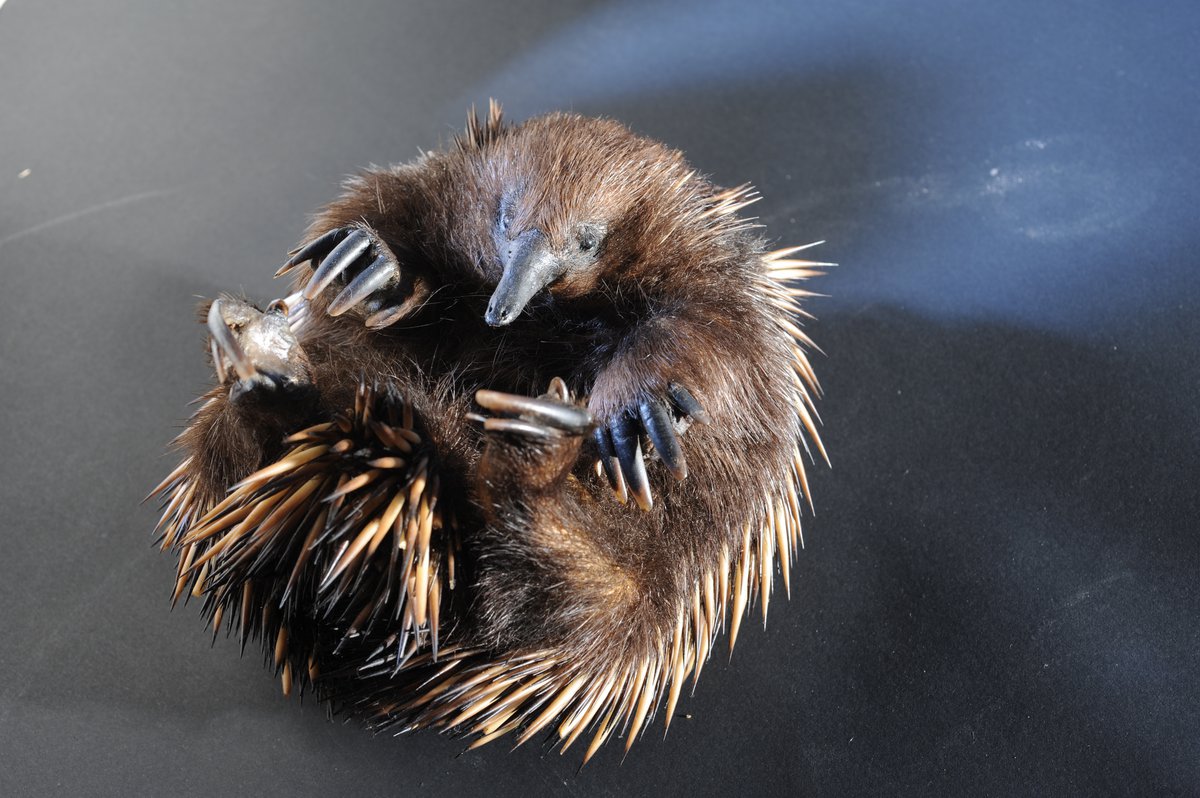
Real Echidna notice the difference of the rear foot.

“Our Australian echidna at The Zoology Museum Cambridge UK, has a taxidermied echidna on display. To an Australian, the specimen in the museum doesn’t look right. Superficially, it looks like it’s been stuck in a wind tunnel, its spines are too sleek. Whereas if you watch a live echidna, they are round and waddle. But that’s not it. Upon closer inspection, the echidna is anatomically incorrect.- has feet which point in the wrong direction and consequently, rips across the ankles(see photograph on left). Echidnas were so unfamiliar to people in London that the taxidermist didn’t realise that their feet should point backwards. We won’t be correcting this mistake as it forms in Grant Museum of Zoology valuable evidence of the ways these animals were historically understood,” said Jack Ashby, Manager of the Grant Museum of Zoology, part of UCL Culture.

Tazzie

Why I love Echidnas!

I love Echidnas! (also known as Spiny ant Eaters colloquially ). I have Echidnas who live and visit my garden and in the surrounding bush. I wanted to share what makes these animals so awesome.

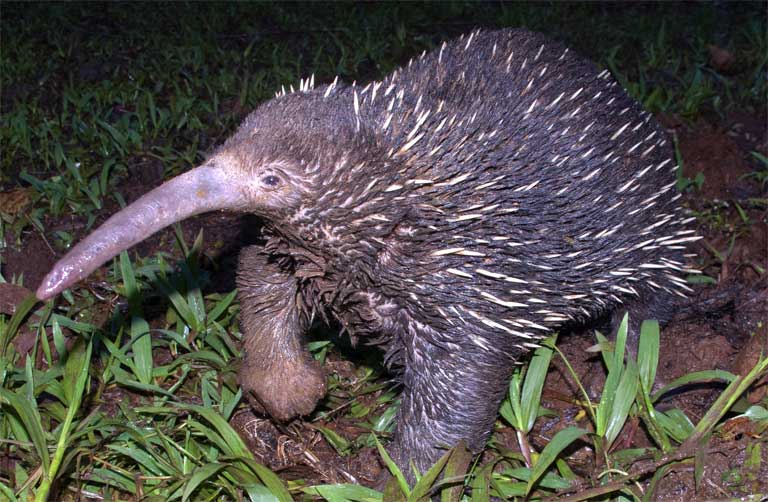
The Long beaked (nose) Echidna found in the Highlands of New Guinea, Indonesian Papua, and the Short beaked (nose)found in Australia. Even though some people call them Spiny ant Eaters they are not related to them at all! Nor to Hedgehogs, Porcupines or Pangolins.

Long Beaked Echidna. are in danger even as they are eaten by indigenous people in the hills of New Guinea and Papua, They are also in danger from deforestation.

The western long-beaked echidna (Zaglossus bruijni), The eastern long-beaked echidna (Zaglossus bartoni), Sir David Attenborough’s long-beaked echidna (Zaglossus attenboroughi) is one of the three species of the genus Zaglossus. (https://www.worldatlas.com/articles/the-five-species-of-monotremes-living-today.html) If you wish to know more about the Long Beaked Echidna please look up the link above.

@Echidna Home 2019

The Short Beaked Echidna (Tachyglossus aculeatus) is the smaller of the two. In Tasmania you can often see them especially by the edges of the roads and even crossing the roads. Sadly as they move slowly they do get hit by cars.

I am very fortunate to have at least one living in and about my property. I will go into more about their territory and life in another post.

@Echidna Home 2019
@Echidna Home 2019.

They are amazing and fascinating animals.

Mammals are a diverse group, but all mammals-

  • produce milk to feed their young
  • have hair or fur
  • have a unique jaw structure
  • are warm-blooded

Echidnas are mammals? Yes.

But they have spines (which are actually tough hair folicles). Yes but they also have fur to keep them insulated so in colder regions you will see that Echidnas have longer fur covering some of their spines. If you compare my local Echidna with the picture below of an Echidna from NSW with a warmer climates you can see that it has less fur covering its back. So yes they have fur. Check. You can see more of it in the curled up photo on the right below.

(Tachyglossus aculeatus)
Image: Stuart Humphreys © Australian Museum
A Short Beaked Echidna is pictured with its snout to the surface of a wet rock. Its spines are yellow with a black tip, whilst its snout appears to be a bluish-brown colour. The echidna is an oval shape, with a ball-like appearance.
Image: Kathy Atkinson
© Australian Museum

Mammals are warm blooded, yep Echidnas are warm blooded.

Echidnas and Platypus are Monotremes, they lay eggs and their babies hatch.

Echidnas breed in Winter. Now the mother doesn’t have a pouch all the time. It is pretty amazing how she creates one; she does this by contracting her abdominal muscles which then forms a fold which is secure enough to hold the egg and puggle after hatching. (WIRES Northern Rivers. http://www.wires.org.au) and a single soft shelled egg is laid (like birds and reptiles).

The puggle (a baby Echidna) hatches out of the egg after about 10 days. As it is developing the puggle will grow a tooth structure, like chicks have, known as a ‘egg tooth’ a small sharp structure on a chicks beak to help it break the shell and hatch. Watch the video (below) of a puggle hatching and see if you can spot its egg tooth. Puggles are born blind with no spines or fur and it will be about the size of a jelly bean 1.45cms and can weigh in at as little as 380milligms/0.0134041ozs! (https://www.environment.nsw.gov.au/topics/animals-and-plants/native-animals/native-animal-facts/echidnas)

Echidna pouch after loss of egg or small puggle
@Leoni Byron-Jackson http://www.wiresnr.org/echidna.html
A one month old puggle. It will stay in its mother’s pouch for about two months, spending all of its time lapping up milk and sleeping
© Chris Eastland/ZooBorns 

Since there is no nipple for the puggle to cling too it will cling to its mothers fur about her belly with its front legs that are incredibly developed and strong. but clings with its well developed front legs to the hairs on the mother’s belly.

Mammals feed their young milk. Check.

Whilst most mammals have nipples Monotremes do not. Instead in Echidnas the mother produces milk and it is excreted through the milk patches. Areas of the mothers stomach flat skin on either side of the pouch about where you would find teats or nipples on other mammals. The milk is excreted and the puggle will suckle at the patches not lick them. Patches are located on either side of the pouch approximately where one would expect a teat or a nipple to be.

Image result for how do  echidna puggles drink from their mothers
Newman has been reared, with keepers feeding him a milk mixture
out of the palm of their hands. Credit: News Corp Australia, Taronga Zoo

The young laps at the milk patches, it does not suckle. Echidnas, the Different Mammal Dr. Peggy Rismiller OAM Anatomical Sciences, University of Adelaide, Adelaide, South Australia 5005

@Image by Sharon McGrigor
69 day old Puggle being raised at Western Australia’s Perth Zoo.. This is of an age where it would no longer be living in its mother pouch. You can see its ear fold an the spines beginning to develop @Perth Zoo Western Australia.

The puggle stays in the pouch for a further approximately 50 days until it starts to develop its spines, at which time mum will dig a nursery burrow in which she will leave the puggle. http://www.wiresnr.org/echidna.html The Puggle suddenly finds itself no longer clinging to its mother feeding when ever it desires warm snug and safe in its nestled in its mothers pouch. It now finds itself alone in a much cooler place where its mother will only return to feed it once every five days and it will only be with the puggle for a few hours. Echidnas, the Different Mammal Dr. Peggy Rismiller OAM Anatomical Sciences, University of Adelaide, Adelaide, South Australia 5005 (Rismiller 1999; Rismiller and McKelvey 2009)

It goes from clinging to the belly of its mother and having access to the milk patch at all times to being left alone in a cool (15 – 18°C) chamber .

@Taronga Zoo Sydney NSW AU, 2016

Many of us have had encounters with these animals in the garden, where they may dig them selves in to the ground, if this happens it is due to the animal being frightened, leave it alone, remove the threat (usually the family dog) and the echidna will go on its way once it feels secure. We can not relocate an echidna, they are solitary animals and have a territory, and if removed from this territory they will make every effort to return, crossing unfamiliar territory, also as we do not know if it is a male or female it could have a puggle waiting in a hollow for the next feed. wires.org.au

If you are interested in reading more about Echidnas and their lives I will be posting more on these endearing unique animals.

Tazzie

Blog at WordPress.com.

Up ↑

Design a site like this with WordPress.com
Get started